Upright
Transition may be bittersweet, but distance can restore perspective. Take only the lessons you need.
 Arcana
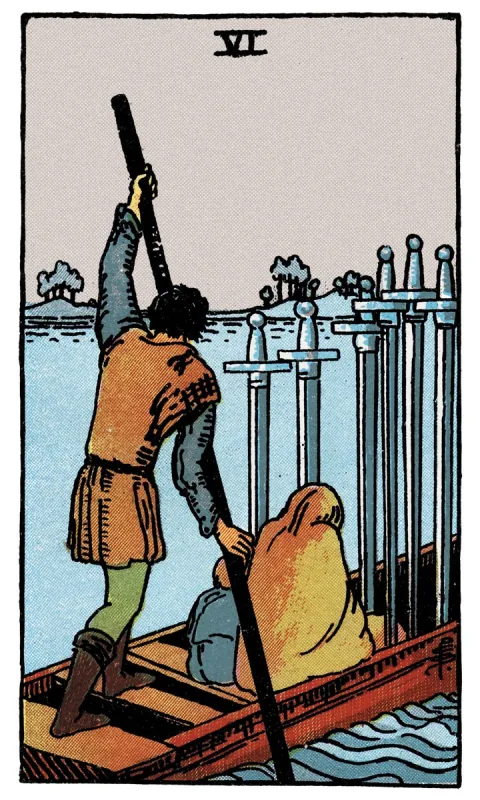
Swords · 6
Move toward calmer water
Six of Swords often appears in searches about move toward calmer water. Its most useful reading begins with the real situation: what is happening, what remains within your influence, and what small step is available now.
Transition may be bittersweet, but distance can restore perspective. Take only the lessons you need.
Resistance, unfinished business, or carrying old trouble forward may slow passage.
A grounded guide
Swords belong to air: thought, truth, language, conflict, and the choices made when clarity is required. The rank describes movement toward balance. Together with the Rider–Waite–Smith scene, Six of Swords turns that pattern into a concrete situation you can examine.
Swords belong to air: thought, truth, language, conflict, and the choices made when clarity is required.
Transition may be bittersweet, but distance can restore perspective. Take only the lessons you need. When upright, the card is more useful as an invitation than as a promise. Ask where you can notice, choose, or act differently. Six of Swords becomes constructive when its theme is translated into behavior that fits the facts rather than treated as a vague assurance.
A practical next step: Make the next part of leaving concrete.
Resistance, unfinished business, or carrying old trouble forward may slow passage. A reversed card is not automatically negative. Its energy may be blocked, excessive, delayed, or operating inwardly. Check those possibilities before deciding which one fits, and avoid using the card to label yourself or another person.
A common mistake with Six of Swords is turning a vivid image into a fixed conclusion. The same card can describe an external event, an internal stance, or an approaching choice. The question, spread position, and reader's actual circumstances determine which layer is relevant.
In relationships, Six of Swords asks how “move toward calmer water” is showing up between people. Transition may be bittersweet, but distance can restore perspective. Take only the lessons you need. Use the card to prepare an honest conversation rather than to guess another person's mind.
For work or study, Six of Swords turns attention toward time, ability, and agency. Transition may be bittersweet, but distance can restore perspective. Take only the lessons you need. A useful next move is to make the next part of leaving concrete.
With money, read Six of Swords as a prompt about habits, priorities, and risk—not a forecast of profit or loss. Transition may be bittersweet, but distance can restore perspective. Take only the lessons you need. Check the numbers and consult a qualified professional before a major decision.
For wellbeing, Six of Swords is not a diagnosis. It can help you notice the pace, feeling, or pattern that needs care. Transition may be bittersweet, but distance can restore perspective. Take only the lessons you need. Seek qualified support when distress is persistent or overwhelming.
Work with this card
“Where is “move toward calmer water” already present in your life?”
A practical next step: Make the next part of leaving concrete.
Six of Swords is more useful as context than a fixed yes or no. Its theme—move toward calmer water—can show what supports the decision and what still needs examination.
Resistance, unfinished business, or carrying old trouble forward may slow passage.
Make the next part of leaving concrete. Then observe real-world feedback rather than waiting for the card to change the situation.